
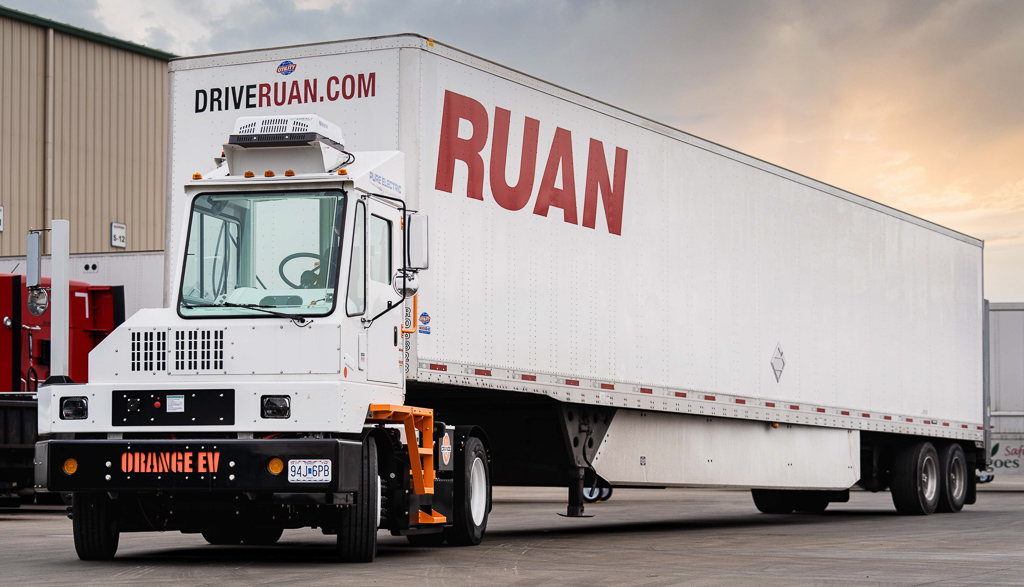
Ruan Adds Another EV Terminal Tractor to Fleet

2026-01-26T13:07:11-06:00April 27, 2022|3rd Party Logistics|

terminal tractor will be based in St. Joseph, Missouri, after the carrier found success with its first EV yard tractor in Minnesota. The carrier added its first Orange EV truck 18 months ago. The company, which ranks No. 37 on the list, announced this month that the EV tractor is part of its movement to explore alternative fuels for heavy-duty equipment to create a more energy-efficient supply chain. “To provide clean, efficient solutions for our customers, Ruan tests and invests in the latest technologies,” said Brad Gehring, Ruan’s VP of fleet services. Ruan also is testing compressed natural gas (CNG), renewable natural gas (RNG), biodiesel blends, and renewable hydrocarbon diesel within its fleet of 3,500 vehicles. Gehring added that the Orange tractor at its Minnesota terminal has been a reliable piece of equipment that has “exceeded uptime expectations.” A recent study on electric commercial vehicles found that terminal tractors are one of the best paths for Class 8 tractor conversion to battery-electric vehicles. Orange EV has more than 100 fleet customers across the country using about 400 of its tractors. “If you’re only a heavy-equipment operation, we suggest yard tractors as a way to go electric,”  , then box trucks, then short regional haul of beverage and groceries, then longer regional day cabs, and ultimately sleeper tractors.” The Orange EV tractor part of the NACFE study was Ruan’s yard dog running in Minnesota. “That tractor has been there for a year and a half—and I don’t think it’s missed a single day of service,” Zack Ruderman, Orange EV VP of sales and marketing, told after the NACFE study was released in March. “When we talk about the reduction in maintenance costs—that’s one piece of it—but the improvement in uptime is another piece of it.” Along with being low-hanging fruit for companies looking to reach sustainability goals, EV yard tractors have early records of reduced maintenance costs, according to NACFE. The quieter and smoother-moving vehicles also offer a better working environment for operators, the NACFE noted. “We have received positive feedback from our drivers, saying that they prefer the modern technology of the BEV yard spotters,” Tim Burke, the VP of transportation for . “They like that these EV terminal tractors improve uptime, do not require fueling, and there’s less preventive maintenance. They also appreciate that they are quiet, cool, and odorless.” Orange EV’s Ruderman noted that the NACFE study also should alleviate fleet worries about EVs operating in colder climates. “Cold weather is a common concern,” he said. “Fleets want to know if it will work. Meanwhile, diesel fuel gels in really cold weather—an issue you don’t have with EV yard tractors.” During the NACFE tests, Ruan reported temperatures as low as 33 degrees below zero Fahrenheit. “They had no issues,” Ruderman said. “The truck works fine. It just uses more energy to heat the cab and heat the battery boxes to make sure the batteries don’t get too cold.” Ruan noted that its exploration of alternative fuels eliminated hundreds of thousands of tons of carbon dioxide this decade. The 90-year-old, family-owned transportation and logistics management company offers dedicated and managed transportation, warehousing, and brokerage services across the U.S. It plans to further its sustainability efforts by adding more EV terminal tractors across the country, Ruan announced earlier in April. The carrier’s St. Joseph EV tractor was partially funded with a . Published: { "@context": "", "@type": "ImageObject", "contentUrl": "", "contentlocation": "United States", "url": "", "name": "Orange EV Charging Battery Station", "description": "Orange EV suggests that fleets take advantage of opportunity charging to keep the tractors' batteries powered to optimal levels during operations.", "provider": { "@type": "Organization", "name": "Orange EV", "url": "", "image": "" } } { "@context": "", "@type": "ImageObject", "contentUrl": "", "contentlocation": "United States", "url": "", "name": "Ruan - Orange EV Electric Truck with Ruan Trailer_2022-1-17", "description": "Ruan Orange EV All Electric Terminal Truck", "datePublished": "2022-04-26", "provider": { "@type": "Organization", "name": "Orange EV", "url": "", "image": "" } }
Electric Vehicles Match Diesel Performance in the Cold

2025-10-10T14:32:04-05:00February 15, 2022|Yard Trucks|

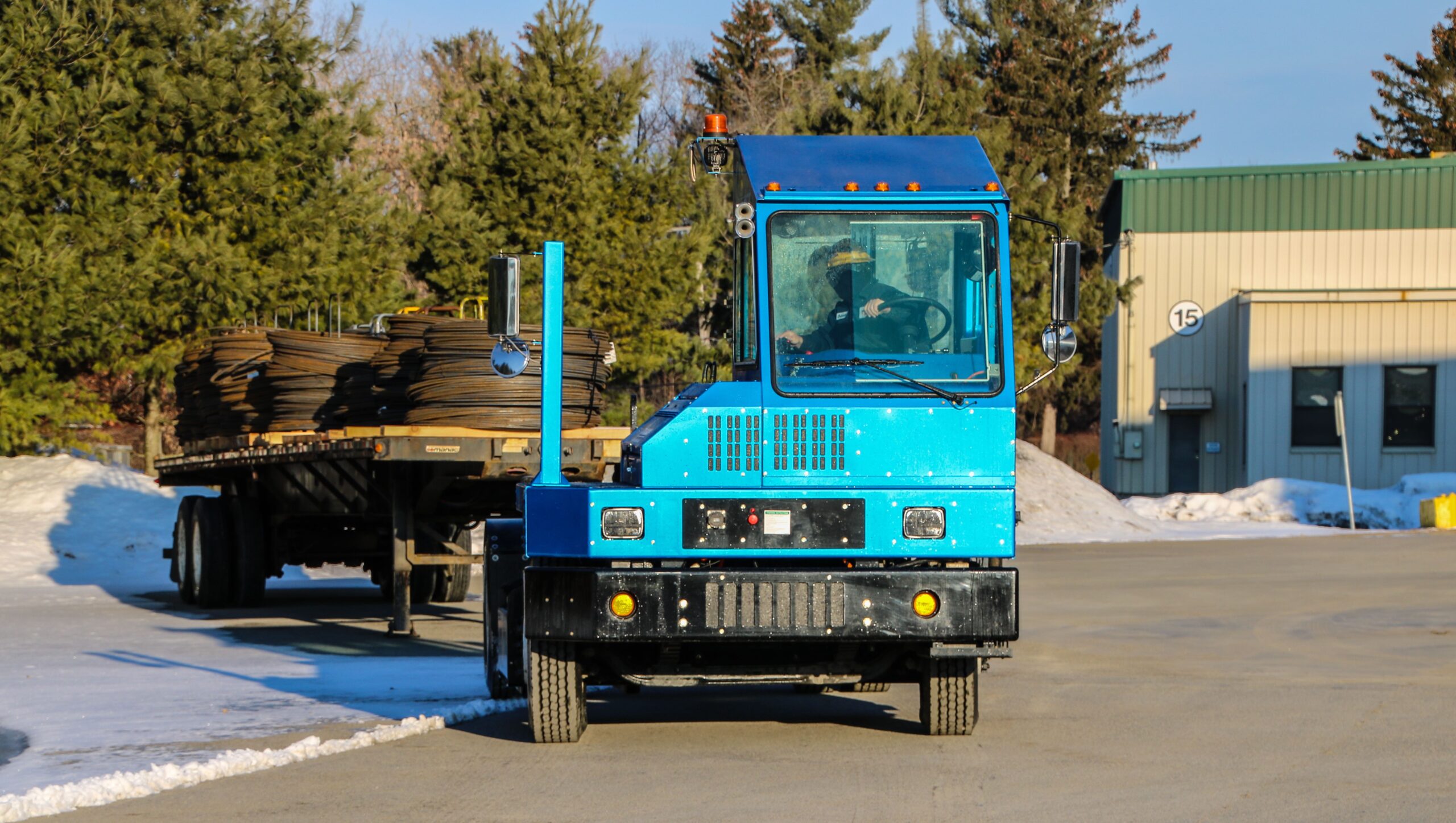
As battery-electric vehicles gain popularity for different uses in transportation, some are wondering if they can perform in the cold and harsh environments that diesel vehicles handle well. Just as mileage for conventional vehicles depends on several factors, the range for EVs can vary with cold weather, high-speed driving or accessory use, according to the . Accessory power use for things like heating a vehicle’s cabin can impact the energy consumption and vehicle range for EVs. “Unlike fossil fuel-powered vehicles, the thermal energy available from the electric motor is not able to meet heating demands in winter, and the energy consumption related to heating can significantly affect the vehicle performance in terms of range,” said a done at the University of Brescia in Italy. The study used publicly available Nissan Leaf data to model the impacts of accessory power consumption such as cabin heating on energy consumption for EVs. The data was based on an experiment in which the Nissan Leaf’s range was tested across a broad range of winter ambient temperatures in Canada. The study concluded: “The effect of ambient temperature and the consequent accessories consumption due to cabin heating are shown to be remarkable. For instance, in case of driving cycles, the range exceeds 150 kilometers at 20 degrees C, while it reduces to about 85 kilometers and 60 kilometers at 0 degrees C and minus 15 degrees C, respectively.” That’s the equivalent of going from a range of 93 miles at 68 degrees Fahrenheit to 53 miles at 32 degrees F and 37 miles at 5 degrees F. Of course, this is for a short-range passenger EV. Research on the performance of electric trucks in cold weather is scarce. Terminal tractors, or yard trucks, rarely leave their home base. Yard trucks are the , because they don’t have to travel long distances. They can quickly find a charger when there’s down time or when they need to reenergize their batteries. “The actual performance of our Orange EV yard truck is not any different in hot or cold weather — it just uses more energy in cold weather,” Kurt Neutgens, president and CTO of Orange EV, told FreightWaves. Like any vehicle, EVs need to be designed and adapted for the environments they operate in, Neutgens said, but that can be accomplished. “Because of the additional energy used to heat the battery boxes and the cab, it is possible that operations in extreme cold could use 3 to 6 kilowatts more energy per hour than when temperatures are in the 70s,” Neutgens said. It depends on the temperatures and how efficient the heaters are, he said, so it’s important to test batteries in cold weather and pay attention to the battery pack size companies purchase for their EVs. The Kansas City-based electric terminal tractor provider has had yard trucks operating in snowy and cold environments for years. “Our coldest location is likely in Otsego, Minnesota, at a Ruan facility. In that part of Minnesota, it’s not uncommon to hit minus 20 degrees F for multiple days, and it’s been down to minus 33 degrees Fahrenheit with our truck operating. … The snowiest Orange EV location is likely Buffalo, New York, where our trucks have been operating successfully for five years,” Neutgens said. In the 2018 to 2019 winter season, Buffalo received 94 inches of snowfall, and the average annual snowfall for the city was 70 inches between 1981 and 2010, according to the . Orange EV yard trucks have heating elements inside the battery boxes, so the batteries can continue to supply power and run the truck as normal in frigid temperatures, Neutgens said. Though they can take energy from the battery, electric heaters can heat up the cab faster than a diesel engine, he said. “Any fleet operator considering a switch to electric vehicles has concerns regarding duty cycle and range of the assets. But in the evaluation, they have to also take into account the terrain and weather conditions,” said Tyler Cole, director of carbon intelligence at FreightWaves. Cole continued: “If they’re sacrificing substantial range in extreme temperatures, it’s going to weigh into their asset purchasing decision. For the last mile, light-to-medium-duty trucks and drayage operations, that’s probably less of a constraint. But any long-haul operator looking at EV trucks in the medium term is appropriately weighing the trade-offs between the total cost of ownership and interoperability of its assets.” to extend EV range in the winter include: Because EVs take more energy in cold environments, it’s important for companies to keep a charger open to keep the batteries warm and recharge trucks when needed, Neutgens said. Published: { "@context": "", "@type": "ImageObject", "contentUrl": "", "contentlocation": "United States", "url": "", "name": "Electric yard truck operating in New York", "description": "Electric yard truck operating in New York", "datePublished": "2022-02-16", "provider": { "@type": "Organization", "name": "Orange EV", "url": "", "image": "" } }

Oakland Pallet Deploys Orange EV Electric Yard Truck for Product Staging and Local Delivery

2026-01-26T12:07:04-06:00October 31, 2018|Manufacturing|

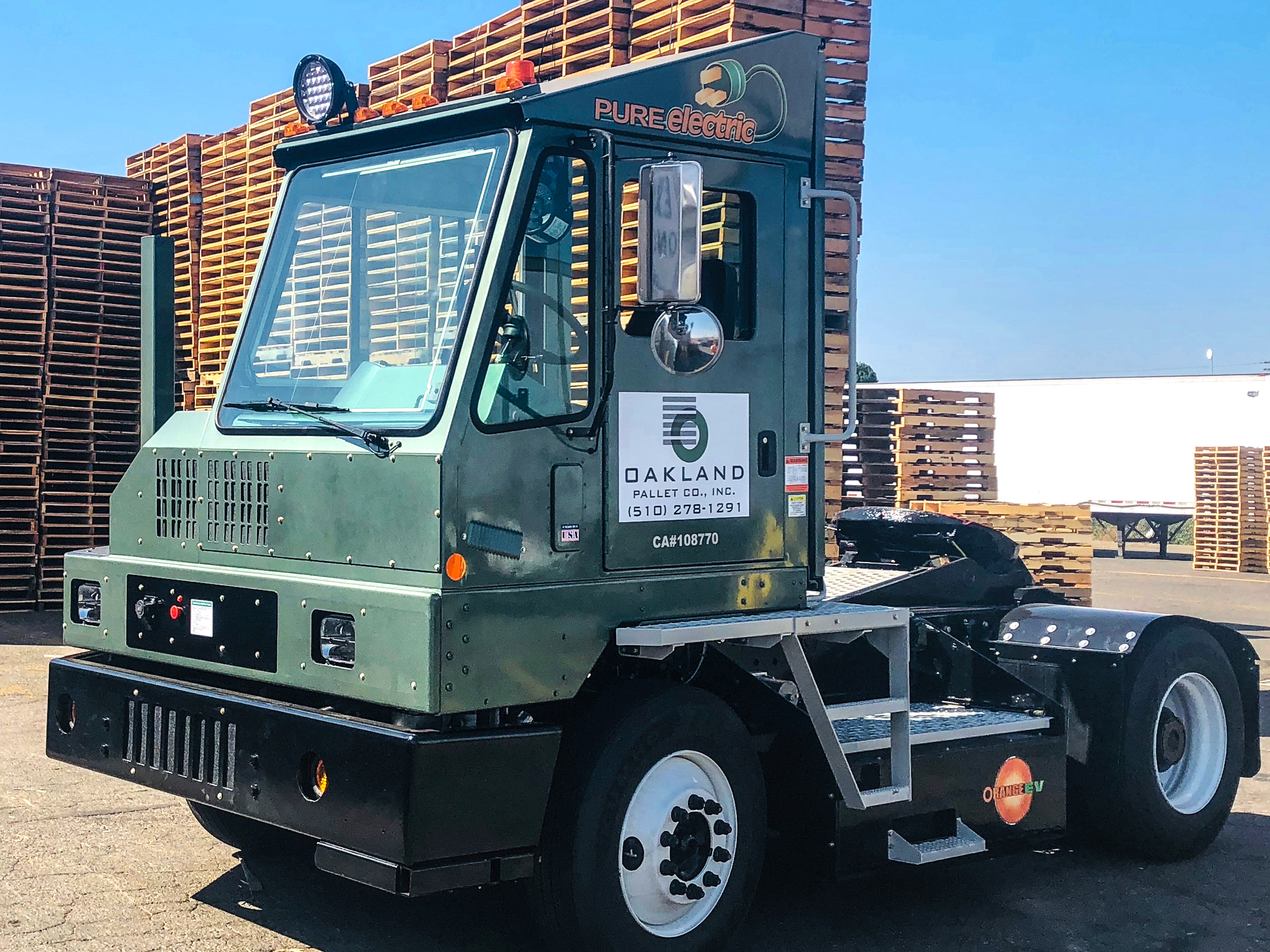
KANSAS CITY, MO and SAN LORENZO, CA, October 31, 2018 - (OPC) today announced the deployment of an Orange EV T-Series pure electric terminal truck to the Oakland Pallet manufacturing and recycling facility in Modesto, CA. The 100% electric Class 8 truck, charged with on-site solar, moves product on-site and makes local deliveries. "When purchasing a new truck, we chose electric over diesel for a few reasons, most importantly to reduce emissions in our Modesto community by utilizing our solar array for power instead of diesel combustion," said Carlos Padilla, Vice President and co-owner of Oakland Pallet.  “But the beauty of the Orange EV terminal tractor is that it can be used to make local deliveries and pick-ups without tying up a long-distance tractor and driver." Terminal trucks (aka yard trucks, hostlers, spotters, goats) typically operate within the confines of container-handling facilities but can also be plated and registered for on-road use. Orange EV trucks are available in a , designed to meet site-specific requirements. For Oakland Pallet, the decision to deploy electric was both .  Conscious of the source and lifecycle of their energy consumption, OPC installed a solar array at the Modesto operation. “Investing in the Orange EV truck was a win-win. It’s charged with on-site solar so doesn’t add to our energy costs, and it eliminates diesel costs and emissions,” commented Samuel Garza, Modesto Plant Manager. “The telematics also save money and time, sending automatic notifications so we can take care of small issues before they become big problems.” All Orange EV trucks are equipped with an onboard telematics system which provides real-time data for operations and reporting. In addition to upcycling and recycling pallets, Oakland Pallet is committed to sustainability in all aspects of their operations, recovering and downcycling 600,000 cubic yards of carboard, plastic, metal, and wood last year. “Our pallets are always on the move, used to transport products throughout the world. It’s our job to do what we can to minimize our environmental impact,” said Leticia Padilla, OPC’s Sustainability Program Manager. “The Orange EV truck has improved our community and work environment with reduced noise and emissions, and our driver loves that it’s so comfortable and easy to use.  The charger was easy to install, and the battery has always had plenty of charge for our operations.  Fleets don’t know what they’re missing – heavy duty electric is here, and it works.” Oakland Pallet utilized funding from the Hybrid and Zero-Emission Truck and Bus Voucher Incentive Project (HVIP) to purchase their Orange EV truck.  HVIP is currently open, enabling discounts of up to $165,000 per Orange EV terminal truck. , OPC is committed to reducing its environmental footprint, offering best quality, sustainable pallet solutions.  Oakland Pallet’s customer-base spans a wide range of industries including wineries, tech, food & beverage, major DC's, and a variety of manufacturing companies throughout California. Kansas City based into container handling operations. { "@context": "", "@type": "ImageObject", "contentUrl": "", "url": "", "contentlocation": "US", "name": "Oakland Pallet Orange EV Truck", "description": "Pure electric forest green orange ev terminal truck is parked outside with pallets in the background", "provider": { "@type": "Organization", "name": "Orange EV", "url": "", "image": "" } } { "@context": "", "@type": "ImageObject", "contentUrl": "", "url": "", "contentlocation": "US", "name": "Oakland Pallet Orange EV Truck", "description": "Pure electric forest green orange ev terminal truck is parked outside with pallets in the background", "provider": { "@type": "Organization", "name": "Orange EV", "url": "", "image": "" } }

Go to Top