
Ruan Adds Another EV Terminal Tractor to Fleet

2026-01-26T13:07:11-06:00April 27, 2022|3rd Party Logistics|

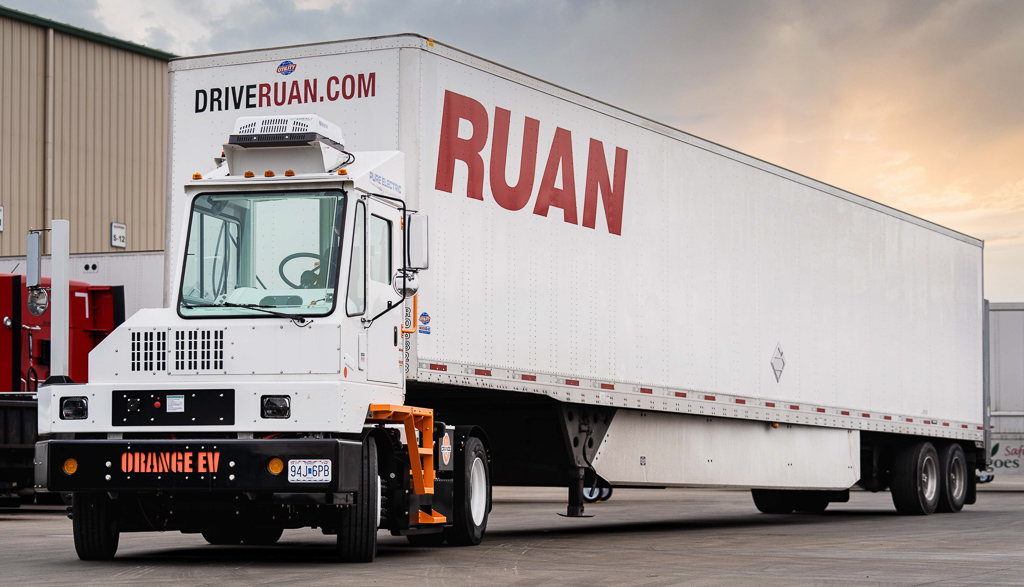
terminal tractor will be based in St. Joseph, Missouri, after the carrier found success with its first EV yard tractor in Minnesota. The carrier added its first Orange EV truck 18 months ago. The company, which ranks No. 37 on the list, announced this month that the EV tractor is part of its movement to explore alternative fuels for heavy-duty equipment to create a more energy-efficient supply chain. “To provide clean, efficient solutions for our customers, Ruan tests and invests in the latest technologies,” said Brad Gehring, Ruan’s VP of fleet services. Ruan also is testing compressed natural gas (CNG), renewable natural gas (RNG), biodiesel blends, and renewable hydrocarbon diesel within its fleet of 3,500 vehicles. Gehring added that the Orange tractor at its Minnesota terminal has been a reliable piece of equipment that has “exceeded uptime expectations.” A recent study on electric commercial vehicles found that terminal tractors are one of the best paths for Class 8 tractor conversion to battery-electric vehicles. Orange EV has more than 100 fleet customers across the country using about 400 of its tractors. “If you’re only a heavy-equipment operation, we suggest yard tractors as a way to go electric,”  , then box trucks, then short regional haul of beverage and groceries, then longer regional day cabs, and ultimately sleeper tractors.” The Orange EV tractor part of the NACFE study was Ruan’s yard dog running in Minnesota. “That tractor has been there for a year and a half—and I don’t think it’s missed a single day of service,” Zack Ruderman, Orange EV VP of sales and marketing, told after the NACFE study was released in March. “When we talk about the reduction in maintenance costs—that’s one piece of it—but the improvement in uptime is another piece of it.” Along with being low-hanging fruit for companies looking to reach sustainability goals, EV yard tractors have early records of reduced maintenance costs, according to NACFE. The quieter and smoother-moving vehicles also offer a better working environment for operators, the NACFE noted. “We have received positive feedback from our drivers, saying that they prefer the modern technology of the BEV yard spotters,” Tim Burke, the VP of transportation for . “They like that these EV terminal tractors improve uptime, do not require fueling, and there’s less preventive maintenance. They also appreciate that they are quiet, cool, and odorless.” Orange EV’s Ruderman noted that the NACFE study also should alleviate fleet worries about EVs operating in colder climates. “Cold weather is a common concern,” he said. “Fleets want to know if it will work. Meanwhile, diesel fuel gels in really cold weather—an issue you don’t have with EV yard tractors.” During the NACFE tests, Ruan reported temperatures as low as 33 degrees below zero Fahrenheit. “They had no issues,” Ruderman said. “The truck works fine. It just uses more energy to heat the cab and heat the battery boxes to make sure the batteries don’t get too cold.” Ruan noted that its exploration of alternative fuels eliminated hundreds of thousands of tons of carbon dioxide this decade. The 90-year-old, family-owned transportation and logistics management company offers dedicated and managed transportation, warehousing, and brokerage services across the U.S. It plans to further its sustainability efforts by adding more EV terminal tractors across the country, Ruan announced earlier in April. The carrier’s St. Joseph EV tractor was partially funded with a . Published: { "@context": "", "@type": "ImageObject", "contentUrl": "", "contentlocation": "United States", "url": "", "name": "Orange EV Charging Battery Station", "description": "Orange EV suggests that fleets take advantage of opportunity charging to keep the tractors' batteries powered to optimal levels during operations.", "provider": { "@type": "Organization", "name": "Orange EV", "url": "", "image": "" } } { "@context": "", "@type": "ImageObject", "contentUrl": "", "contentlocation": "United States", "url": "", "name": "Ruan - Orange EV Electric Truck with Ruan Trailer_2022-1-17", "description": "Ruan Orange EV All Electric Terminal Truck", "datePublished": "2022-04-26", "provider": { "@type": "Organization", "name": "Orange EV", "url": "", "image": "" } }
EV Opportunities are Blooming in Terminal Yards

2025-10-13T10:58:15-05:00April 25, 2022|Terminal Tractors|

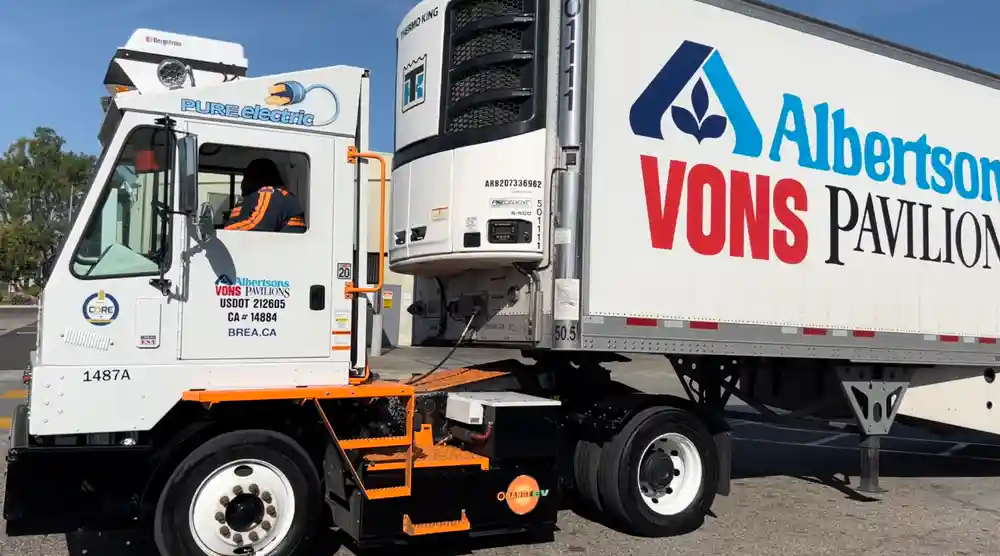
Most corporations are looking more seriously at sustainability than ever before. But in the trucking industry, still dominated by fossil fuels, it can be tough to know where to start. Some fleets are not looking at over-the-road operations—they’re finding early zero-emissions victories in their yards. Albertsons, the second-largest grocery chain in the U.S., is finding sustainability success since it began using battery-electric terminal tractors at some of its 19 terminals. The EV yard tractors prove to be one of the best ways for fleets to test how alternate-powered Class 8 vehicles could fit into operations. “As part of . “We currently have 11 EV terminal tractors with plans to purchase seven more this year.” Albertsons' 120 diesel-powered terminal tractors will still outnumber the 18 EV yard tractors it expects to have by 2023. But that is not likely to last long, according to two recent industry studies that note how yard tractors are prime equipment for electrification. “These conversions are happening now—and it’s happening rapidly,” Zack Ruderman, VP of sales and marketing for , said. “We’re investing to significantly increase our production capacity to more than double this year versus last year.” Albertsons is one of Orange EV’s more than 100 fleet customers across the U.S. Ruderman told  (NACFE) study highlighted the potential efficiency of EV yard tractors. “We acknowledge that electrification can be difficult, especially in the Class 8 market,” , NACFE’s executive director, said. “But right now, the electrification of terminal tractors makes sense and is a good place for fleets to begin their electrification journey.” NACFE recently released the first of four trucking market segment reports from its freight efficiency study. The council found “terminal tractors one of the best, if not the best, paths for heavy-duty tractor fleets to learn about and implement a BEV in a fleet operation.” . Along with the environmental benefits and reduced maintenance costs of EVs, NACFE noted that the electric terminal tractors provide a better workplace for drivers because they’re quieter and smoother than the diesel versions. “We have received positive feedback from our drivers, saying that they prefer the modern technology of the BEV yard spotters,” Albertsons' Burke said. “They like that these EV terminal tractors improve uptime, do not require fueling, and there’s less preventive maintenance. They also appreciate that they are quiet, cool, and odorless.” BEV terminal tractors can also be used inside warehouses with no emissions—not just yards, NACFE noted. And maintenance costs for the BEVs can be 60% to 75% less than diesel-powered terminal tractors built after 2017. The stop-and-go nature of terminal work also offers regular opportunities to recharge. “Terminal tractors provide a good use case for electrification because they operate in low mileage applications and can opportunity charge throughout the day while drivers are on breaks,” said Kevin Otto, lead author of the report and NACFE’s electrification technical lead. Burke explained that is a big part of the early success Albertsons has found in its yards. “We have seen positive results in the transition to EV terminal tractors,” he said. “For example, since we run a 24/7 operation, opportunity charging has made the transition so easy and convenient since the EVs do not require dedicated charging times.” Albertsons uses opportunity-charging as part of its standard operating procedure for its drivers, based on Orange EV’s recommendation to maintain an optimal state of charge. “We refined it based on employee feedback after deployment with charging occurring between shifts, during breaks, and meal periods,” Burke added. “If you look at the market in general, the EV technology that is here now—and is very good—is that yard tractor application,” Al Barner, SVP of strategic fleet solutions at . “You’ve got the power source right there where the trucks operate. From drivers’ acceptance, they love them because there’s less noise. They’re more comfortable. It’s a good application—and you’ve got the opportunity-charging.” Fleet Advantage is a truck fleet business analytics, equipment financing, and asset lifecycle cost management company. With today’s supply chain problems delaying new vehicle deliveries, it is crucial to know how fleets manage their equipment and plan for the future. Part of that future planning Barner has seen more of is how to make terminals more sustainable for the environment and fleet employees. An “The technology advances are what’s increasing adoption,” Ann Rundle, VP of electrification and autonomy for ACT Research, said during ACT’s Seminar 66, held in February in Columbus, Indiana. While noting that government regulations have pushed some trucking operations toward EVs in recent years, Rundle said battery technology gains over time would exceed regulatory influences on fleets. “Battery costs are falling as the volumes increase,” she said. “Another thing is battery energy density has been improving over time.” A vehicle battery in 2022 has about three times more power density than the same sized battery in 2012, said Rundle, who was the principal author of the ACT Research study released in December. “So that means either three times more range, one-third less size pack, or you pick how you want to do it. This isn’t theoretical; it is getting better and proving to be better.” The ACT study forecasts all Classes 7 and 8 tractors in the U.S. to be 30% electric by 2030. But Orange EV’s Ruderman said terminal tractors could be closer to full conversion then. “There are a lot of reasons why terminal tractors are an easier EV integration,” he said. “When you talk to fleets about EVs, one of the main concerns is range anxiety: What’s going to happen when I’m out on my route and I need to charge, or I was stuck in traffic, or a different route had more hills that consume more energy, and I’m afraid I can’t get back to home base to charge.” Since most terminal tractors never leave the yard, they are never far from a charging station, Ruderman noted. So opportunity charging, like what NACFE laid out in its study and Albertsons is putting into practice, is enough time to keep a yard EV running in a 24/7 operation. Add in that regenerative braking also charges the tractor. “It turns the frequent starts and stops in the yards into an advantage,” Ruderman said. For fleets interested in getting started or increasing their sustainability efforts, the terminal is a prime place to start. “If you look at the EV market, technology at the yard tractor level is here today and it’s performing well,” Fleet Advantage’s Barner said. “Expanding that technology out to the regional final mile will be the next step.” It was a great place to start for Albertsons, which has 1,400 Class 8 trucks nationwide and its private fleet employs 2,500 drivers. “Fleet sustainability remains top of mind every year as we plan for capital for fleet equipment and infrastructure improvements, as well as foster employee satisfaction,” Burke explained. The company has more than 1,700 stores in 34 states and the District of Columbia. Along with . “Albertsons Companies is committed to integrating sustainability into our everyday business decisions, and that includes reducing emissions within our own operations and our supply chain to help tackle climate change,” Burke said. “We strive to lower our emissions in many ways such as improving fuel efficiency in our trucks, switching to LEDs that use less electricity, and harnessing renewable energy such as wind and solar.” Its over-the-road tractors are all certified by the U.S. Environmental Protection Agency’s for meeting highway transportation sustainability and efficiency standards. “We will continue to explore, pilot, and purchase zero-emission and alternative fuel on-road tractors and refrigeration units for a more sustainable fleet profile while maintaining operational output and deployment across the network, when feasible,” Burke added. Despite supply chain problems plaguing some manufacturers, Ruderman said Orange EV delivers tractors and chargers about 90 days after orders. The OEM has fleet customers in 24 states and expects its market saturation to grow this year. “The broader message is that EV yard trucks are proven,” Ruderman said. “It’s past the experimental stage. We have almost 400 of them in the market across 100 different fleets, different duty cycles, and different parts of the country—in warm weather, in cold weather. The time is now to have that conversation about where to start.” Published: { "@context": "", "@type": "ImageObject", "contentUrl": "", "contentlocation": "United States", "url": "", "name": "orange_ev_albertsons_terminal_tractor.624d8ee6c8246", "description": "Albertsons Orange EV Truck, as seen in FleetOwner", "provider": { "@type": "Organization", "name": "Orange EV", "url": "", "image": "" } }

Go to Top