
As published on the Kansas City Business Journal
The federal government eliminated tax credits for purchasing electric vehicles,
but Orange EV is proving that the cost savings and reliability of its electric
terminal trucks are enough incentive for clients to continue buying them.
The Kansas City, Kansas, company is on pace to triple sales from last year.
Production has gone from about 35 terminal trucks a month when it moved into
a new facility in Kansas City, Kansas in January 2024, to about 120 trucks a
month now. The company hired about 100 people over the last six months and
still has 50 job openings. It now employs 505 people, including 365 in Kansas
City, Kansas.
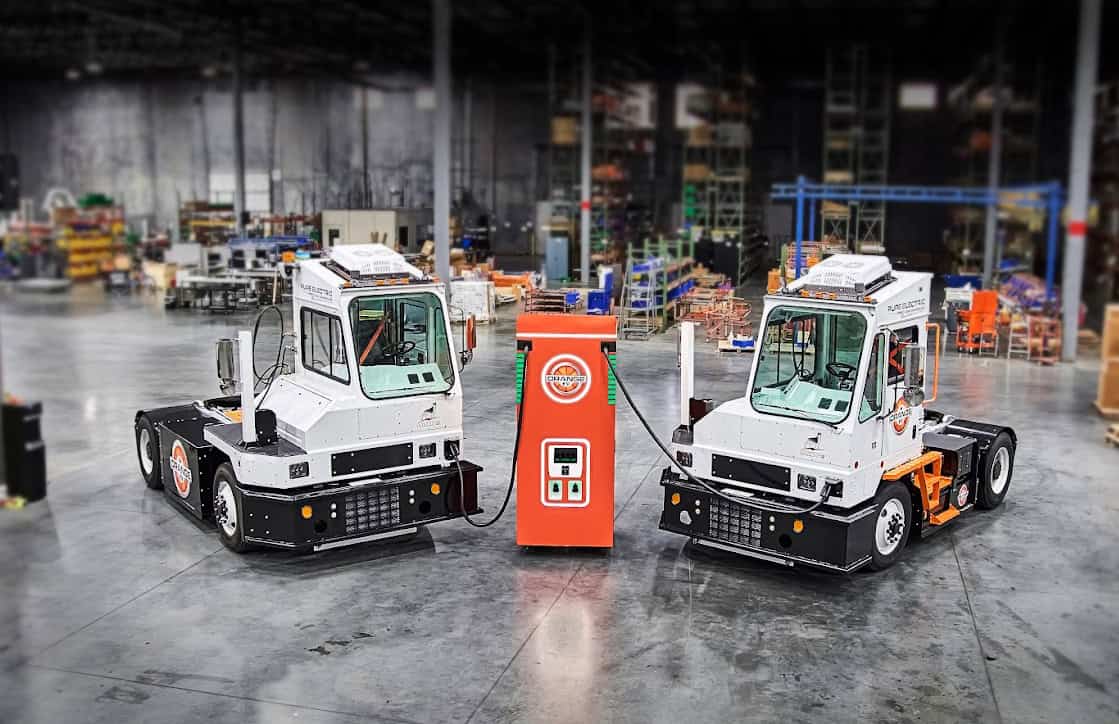
Demand for Orange EV’s electric trucks — used at docks and freight terminals —
continues growing. On June 2, the company received an order for 600 trucks, it’s
largest single order. The company didn’t disclose the name of the buyer.
Orange EV also is making inroads at APM Terminals Pacific Ltd., which operates
Pier 400 in Los Angeles, the largest container port in the Western Hemisphere.
APM recently finished a pilot program testing 20 of Orange EV’s trucks. The
trucks racked up 42,000 operating hours since April 2025, with average uptime of
98.8%. The electric trucks also eliminated the need to consume 40,700 gallons of
diesel, resulting in cost savings of more than $200,000 over the past year.
“They’re realizing that our trucks can improve their operations considerably,”
Kurt Neutgens, president and chief technology officer at Orange EV, said. “Their
costs, their uptime, their ability to do the job, we’re making a difference for them.
So it’s pretty fun. They ran those 20 trucks for a year and what we understand is
they are the best trucks they’ve ever had. So, we’re getting more orders.”
APM now wants to triple its fleet to 60 Orange EV trucks.
Neutgens said sales to a major customer like APM will result in more sales to their
peers, because they all talk to each other. He said it’s generating a lot of
excitement at Orange EV’s plant for what the future may hold.
“From day one, it’s been all about ‘How do we make a better truck?’” Neutgens
said. “My personal mission was to have an impact on the environment and
improve climate change. But our tactic has been to build a truck that’s so much
better that our customers don’t have to care about whether it’s electric or not.
They need it for their operations or they won’t be able to compete.
“If you look at our truck, a customer saves about $500,000 over a 10-year period
without any incentives. As the price of fuel rises, that benefit only grows. That’s
enough to get them excited, so once they get out of diesel, they don’t want to
go back.”
As bright as Orange EV’s future appears to be with electric trucks, it might not be
the most promising product the company is working on.
Orange EV formed a strategic partnership with a startup called OptiGrid in April
2025. The company is developing a charger system that uses a giant battery as a
reservoir of power. Because the charger uses a standard power connection, it
refills its reservoir more slowly, but can save buyers many months it takes to
install higher-capacity power systems. That process can take up to 18 months and
cost a few hundred thousand dollars in permits and fees.
The product OptiGrid created is called the Orange Juicer. Production of the
Orange Juicer is expected to start this fall at Orange EV’s plant in Kansas
City, Kansas.
“We’re going to start slow and make sure we’ve got a great product before we
really ramp up,” Neutgens said. “That market is bigger than the truck market by
multiples. Once that starts rolling, that is going to create a big need for people and
help drive our growth. It’s exciting.”
Published: June 17, 2026/Kansas City Business Journal